
Research
At the core of our research is the study of the interactions of ultra-high intensity, ultra-short pulse laser light with solid targets. Under the everyday conditions to which we are accustomed, the behavior of light with its surroundings is rather unremarkable. The scattering of sunlight via microscopic particles in the atmosphere makes the sky blue. The process of photosynthesis in plants owes its efficiency to the fact that plant cells have evolved to utilize the exact spectrum output by our sun. As humans, we perceive the sensation of warmth when light from the sun interacts with our skin. In every case, a transfer of energy from the photons in the light to molecules is involved. As interesting and important to life on earth as these processes might be, there exists no naturally-occurring, terrestrial process that compares with the feats we are able to manage in the laboratory.
The advancement of ultra-fast laser technologies has allowed for the development of table-top systems that produce star-like conditions. Modern ultra-short pulse lasers have the ability to produce light at intensities commonly exceeding 1020 W/cm2. In comparison, light from the sun has an intensity of about 0.1 W/cm2 at the surface of the earth, depending on the observer's location and the time of year. This is a jump of 21 orders in intensity! The laser system we operate is capable of generating focused, coherent light pulses with duration 40 femtoseconds (1 fs = 10-15 seconds). Consequently, we can generate light with intensities that reach in excess of 1021 W/cm2. Indeed, light at these intensities interacts with matter via mechanisms far from ordinary.
Experiments:
-
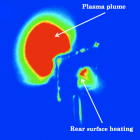
Table-top Laser-driven XUV/X-ray Source
This research is aimed at understanding the fundamental parameters that control the generation of high brightness, ultra-short X-ray pulses..... - Proton beam based cancer therapy
At the core of our research is the study of the interactions of ultra-high intensity, ultra-short pulse laser light with solid targets..... - Neutron/gamma ray sources
The ability to non-destructively detect and identify active nuclear materials as materials and goods cross our boarders is critically important to our security.....
Modeling:
- Large-scale plasma simulations using Pic and Hybrid Pic codes.
- Laser-Generated Particle Beam Transport Using Monte-Carlo Simulations.

Our work doesn't end here. Novel research in the High Energy Density Physics field is performed at exciting locations all over the world. We are proud of our diverse scientific collaborations with notable academic institutes, private industry, and government laboratories.
Our research is funded by